Only 15% of UK Organisations Have a Fully Automated Accounts Payable.
Can Your Finance Operation Scale Without It?
New benchmark research reveals why the AP Automation Gap has become one of the most important priorities in finance transformation.
Accounts Payable has been viewed by the wider business as a back-office function focused on processing invoices and paying suppliers but with the changes in process that e-invoicing brings, the rise of fraudulent attacks and implementation of AI to give quick real time insights means this is rapidly changing.
However, according to a Finance Operations Benchmark Report in 2026, only 15% of UK organisations have fully automated Accounts Payable processes. Nearly seven in ten finance professionals find manual AP processing makes it harder to scale finance operations and four in five CFOs agree.
This highlights an important question for finance leaders, can your finance operation continue to scale without upgrading your Accounts Payable processes?
Accounts Payable as a Strategic Priority
AP projects used to be justified through efficiency gain and measured by a return on investment. How much will the invoice processing costs be reduced, will we eliminate paper and improve our productivity. These were primary objectives, but now the drivers are much wider.
Accounts payable is seen as critical to:
- Financial control
- Business scalability
- Reporting accuracy
- Compliance readiness
- Supplier relationship management
The report found that 70% of CFOs believe their current systems do not provide the level of control needed to address AP inefficiencies.
As organisations grow, invoice volumes increase, approval workflows become more complex and finance teams struggle to maintain visibility across the process and therefore an associated cost of remaining manual.
The Cost of Remaining Manual
Several challenges were found in the report associated with manual AP processes which in turn can become a leadership obstacle.
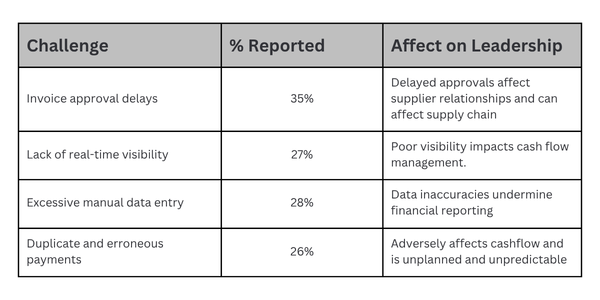
There are some organisations (average employees 100-249) that sit in the ‘middle.’ They have introduced some level of automation but have not achieved the full end-to-end process control. The result is a finance function that sits somewhere between manual processing and true automation.
These organisations have covered the manual data inputting but lack automation around approvals and insights for reporting on real time invoice status’s and bottlenecks.
- 40% report invoice approval delays
- 36% report visibility issues
AI Is Accelerating Change
The research also demonstrates growing confidence in AI. Three-quarters of finance professionals believe AI will free their teams to focus on more strategic activities and for CFOs that figure rises to 80%.
But, it is important to keep some context around the AI. AI is not replacing finance teams but being used to:
- Automate invoice capture
- Improve data accuracy
- Route approvals intelligently
- Reduce manual intervention
- Deliver greater visibility into financial processes
The end result is an empowered finance team spending more time analysing data and supporting business decisions instead of processing transactions.
The top priorities for CFOs when considering future AP solutions are
- Preventing errors and duplicate payments (39%)
- Ensuring compliance and e-invoicing readiness (39%)
- Accelerating invoice approvals (30%)
- Improving audit readiness (30%)
- Enhancing reporting and analytics (29%)
These all point towards strategic business outcomes and away from the operational benefits.
Accounts Payable plays a key role in financial control, operational efficiency, compliance and business growth. As invoice volumes increase, regulatory requirements evolve and finance teams are asked to do more with less, the successful organisations will be those that modernise their AP processes before they become a constraint.
Identifying the gaps that reduce efficiency, and increase cost and risk is no longer about AP automation delivering just value, its actually more about whether your finance operation can continue to scale without it.
For more information on understanding how this affects your organisation we have created a CFO Briefing paper on the Accounts Payable Gap – get your copy here.