E-invoicing reform continues to move from high-level policy into practical implementation. Increasingly, the important questions concern structured data, platform connectivity, invoice routing, validation, lifecycle reporting, supplier onboarding and how compliant invoice exchange will connect with existing Accounts Payable and ERP processes.
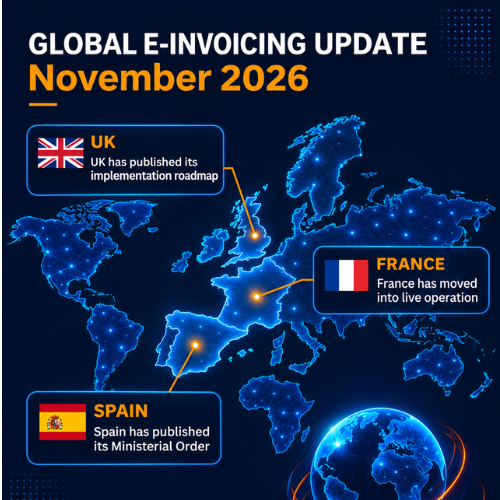
October’s developments have reinforced this direction. France is now operating the first phase of its reform, Spain has published the Ministerial Order that starts its formal implementation timetable, and the UK has issued its roadmap towards mandatory e-invoicing from April 2029. Meanwhile, organisations operating internationally must prepare for a growing variety of local formats, networks and reporting requirements.
Key points
- E-invoicing is becoming an operating-process issue, not simply a tax or invoice-format project.
- Spain has published its Ministerial Order, confirming phased B2B e-invoicing obligations from October 2027 and October 2028.
- France has moved into live operation, bringing invoice routing, data quality and trading-partner readiness into sharper focus.
- ViDA is shaping the longer-term direction of digital reporting and interoperability across the European Union.
- The UK has published its implementation roadmap, confirming Peppol as the core interoperability framework and mandatory e-invoicing for in-scope VAT invoices from 1 April 2029.
- Multinational organisations need a scalable approach that can accommodate multiple national models rather than responding to each mandate as a completely separate project.
Spain confirms its B2B e-invoicing timetable
Spain reached an important milestone in October with the publication of Order HAC/1028/2026, which regulates the country’s public electronic invoicing solution. The Order entered into force on 6 October 2026 and started the formal countdown to mandatory B2B e-invoicing.
Businesses and professionals with annual turnover above €8 million will be required to issue, send and receive electronic invoices from 6 October 2027. They will also need to report invoice and payment statuses. The obligation will extend to other businesses and professionals from 6 October 2028, with further status-reporting requirements applying from October 2029.
Finance teams with Spanish operations should now move from monitoring projected dates to assessing implementation requirements, including structured invoice creation and receipt, invoice-status reporting, faithful-copy submission, platform connectivity and integration with ERP, Accounts Receivable and Accounts Payable processes.
Immediate priorities include:
- creating and receiving structured invoices;
- managing prescribed invoice and payment-status messages;
- retaining an accurate copy and complete audit history;
- connecting invoice exchange with existing ERP, Accounts Receivable and Accounts Payable processes; and
- supporting the onboarding of customers, suppliers and service providers.
Businesses with Spanish operations should obtain written confirmation from their tax, technology and e-invoicing providers on scope, integration responsibilities and implementation plans.
France moves from preparation to live operation
France entered the first phase of its e-invoicing and e-reporting reform on 1 September 2026. Large and intermediate-sized organisations are required to issue electronic invoices, while businesses across the wider economy must be capable of receiving them.
The transition from planning to live operation changes the nature of the project. Organisations must now consider how successfully invoices and status messages are moving through the complete process, rather than concentrating only on technical registration or format conversion.
Practical areas to review include:
- invoice-routing accuracy;
- supplier and customer identifiers;
- mandatory invoice data;
- platform and network connectivity;
- rejected or failed transactions;
- credit notes and invoice corrections;
- links between e-invoicing platforms and ERP systems;
- retention of invoice-status and audit information; and
- ownership of operational exceptions.
France is an important reminder that technical compliance does not automatically create an efficient finance process. Even when invoice data arrives in a compliant structured format, businesses still need controls for coding, matching, approvals, exceptions and posting.
ViDA continues to shape Europe’s longer-term direction
The European Union’s VAT in the Digital Age programme remains central to the longer-term development of e-invoicing and digital reporting across Europe. It includes continued work on technical standards, messaging specifications and the future Digital Reporting Requirements framework ahead of the July 2030 implementation milestone.
This matters because national e-invoicing programmes are not developing in isolation. Although each country may introduce its own implementation timetable, platform model and local requirements, the broader direction is towards more structured invoice data, greater interoperability and faster access to transaction information for tax authorities.
For multinational organisations, ViDA strengthens the case for a coordinated programme covering:
- common invoice-data standards;
- consistent master-data governance;
- repeatable country-onboarding processes;
- integration with ERP, billing, procurement and AP systems;
- central oversight of local compliance requirements; and
- a clear approach to archived documents and audit evidence.
A mandate-by-mandate response may deliver short-term compliance, but it can also create duplicate integrations, disconnected provider relationships and inconsistent operating processes.
The Netherlands confirms its intended direction
The Dutch Government has confirmed plans to introduce mandatory e-invoicing for domestic and intra-EU B2B transactions from 1 July 2030. Digital reporting for intra-EU transactions is expected from the same date, with domestic B2B reporting following from July 2031.
Draft legislation is expected before summer 2027, so detailed technical and operational requirements remain subject to the legislative process. The current policy direction supports the use of the European EN 16931 standard and reinforces the wider move towards interoperable, structured invoice exchange.
The UK publishes its e-invoicing implementation roadmap
The UK Government published its e-invoicing implementation roadmap on 28 October 2026, providing greater clarity about the planned introduction of mandatory e-invoicing from 1 April 2029.
The requirement will apply to VAT invoices issued between in-scope VAT-registered persons, including relevant public bodies. Peppol will form the core interoperability framework, and HMRC will assume the role of UK Peppol Authority.
The roadmap also reinforces an important distinction: a PDF, image file or Word document will not qualify as an e-invoice. In-scope invoices will need to contain structured data that can be exchanged and processed between the financial systems of suppliers and customers.
Important details remain to be finalised, including the complete technical standards, business identifiers, exclusions, certification requirements and detailed guidance for software providers. The Government expects to confirm these elements progressively through 2027 and 2028, ahead of implementation in April 2029.
UK organisations therefore have firmer policy direction, but they should still avoid making premature technology decisions. The immediate priorities remain establishing ownership, mapping invoice flows, reviewing data quality, assessing current systems and obtaining written information from ERP, AP, billing and e-invoicing providers.
Useful preparation includes:
- mapping how invoices are currently sent and received;
- identifying the ERP, AP, procurement and billing systems involved;
- recording invoice volumes by legal entity, country and channel;
- establishing ownership across Finance, Tax, IT and Procurement;
- asking existing providers about Peppol and structured-invoice support;
- reviewing supplier and customer master data;
- documenting the handling of duplicates, failures, corrections and credit notes; and
- identifying where current invoices are processed outside controlled systems.
The Gulf region continues its digital tax transformation
The Gulf region continues to move at different speeds. In the United Arab Emirates, businesses with annual revenue of at least AED50 million reached an important preparation deadline on 30 October 2026, when they were expected to have appointed an accredited service provider. Mandatory e-invoicing for this group is due to begin on 1 January 2027, with further phases following during 2027.
Saudi Arabia remains the region’s most established mandatory programme. The latest confirmed group is Wave 25, covering taxpayers whose VAT-taxable revenue exceeded SAR187,500 in any year from 2022 to 2025. Affected taxpayers must integrate their invoicing systems with ZATCA’s Fatoora platform by 1 February 2027.
Oman has also published a phased timetable beginning in April 2027. Qatar has indicated a legislative direction but has not yet published a final technical model or firm implementation date, while Bahrain and Kuwait have not confirmed equivalent mandatory timetables.
Organisations operating in the region should continue to monitor official tax-authority publications. Local registration status, transaction scope, technical specifications and implementation waves should be confirmed for each relevant legal entity.
Other European programmes continue to evolve
Poland continued to refine KSeF during October. A technical update to the KSeF 2.0 API was deployed, while the Ministry of Finance also indicated that penalty relief would be extended through the end of 2027. The underlying mandate remains in force, and the smallest businesses currently covered by transitional arrangements are still scheduled to enter KSeF from 1 January 2027.
Greece also reached the second phase of its B2B programme on 2 November 2026, extending mandatory requirements to the remaining businesses covered by the rollout.
Belgium and Croatia are already operating domestic B2B requirements introduced in January 2026. Germany continues towards its next issuing phase in January 2027, while Romania’s RO e-Factura framework remains established. Portugal continues to permit qualifying PDF invoices without a qualified electronic signature until the end of 2026, provided the relevant QR code and ATCUD requirements are met.
Asia-Pacific programmes require continued monitoring
Asia-Pacific programmes continue to progress through a mixture of tax-authority clearance, reporting and network-based models. In Singapore, the InvoiceNow requirement extended to new compulsory GST registrants from 1 November 2026, while covered taxpayers in the Philippines are working towards a 31 December 2026 implementation deadline. Malaysia’s phased MyInvois rollout also continues, although the applicable position depends on taxpayer turnover and transaction type.
The region illustrates why global businesses need more than a single European compliance strategy. Requirements can differ substantially in invoice clearance, reporting timescales, digital signatures, recognised formats, government portals, accredited providers, archiving and the treatment of cross-border transactions.
Finance teams should maintain a country-by-country obligation register, but support it with a shared technical and operational architecture wherever possible.
How Documation can help
E-invoicing changes how invoice data is exchanged, but organisations still need an effective process for validating, matching, approving and posting invoices.
Documation connects structured e-invoice data with existing ERP, Accounts Payable and Purchase-to-Pay workflows. Invoice data and supporting documents can be retrieved from connected platforms, transformed and validated, enriched with supplier and company information and passed into the wider P2P process.
From there, existing controls such as duplicate checking, PO matching, coding, approvals, exception management, audit evidence and reporting can continue within a joined-up workflow.
For UK organisations, Documation also provides an e-invoicing readiness review covering current capabilities, systems, invoice data, suppliers, processes and the areas likely to require the earliest attention.
Conclusion
E-invoicing regulation is increasingly moving beyond policy announcements and into practical delivery. France is now in live operation, Spain has confirmed the timetable for its B2B mandate, and the UK has published its implementation roadmap towards April 2029. Together, these developments show why finance teams must prepare for more than a change of invoice format.
The real challenge is creating a scalable process that can handle structured data, multiple networks, local compliance requirements and the operational realities of Accounts Payable and Accounts Receivable.
The organisations best placed to respond will be those that understand their current invoice landscape, establish clear ownership, strengthen data quality and connect compliance requirements with wider finance-process automation.
Book an e-invoicing readiness review with Documation’s Listening Team.