Growth has a way of revealing weaknesses that were previously hidden.
A finance process that worked perfectly well when invoice volumes were lower, supplier relationships were simpler and approval routes were shorter starts to struggle when the organisation grows. Approval delays become more noticeable, reporting takes longer, visibility becomes harder to maintain and teams spend more time chasing, rather than analysing, information.
This issue is often described as a finance efficiency problem, and the team are blamed, the reality is that it’s usually a control problem.
This is where the idea of the Finance Control Gap becomes in to play.
What Is the Finance Control Gap?
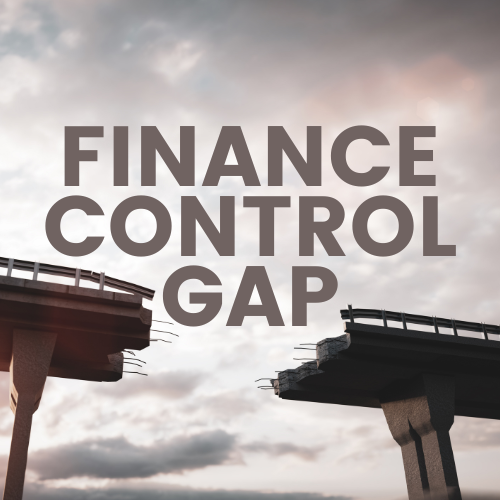
The Finance Control Gap is the difference between the level of financial control an organisation believes it has and the level of control its processes can consistently demonstrate.
It is not a suggestion that finance teams are lacking controls entirely, but more a spotlight on areas where controls have become:
- Delayed
- Fragmented
- Overly manual
- Difficult to evidence
- Lack meaningful visibility for decision-making
Does your Purchase-to-Pay process provide control before money is committed, or only visibility after the event?
Organisations find they can answer questions about spend after invoices have arrived, but struggle to demonstrate control before commitments are made.
Why the Gap Exists
Over the past decade, organisations have invested heavily in finance technology and automation. Despite this investment, many finance leaders continue to experience:
- Approval delays
- Manual intervention
- Duplicate payments
- Weak spend visibility
- Reporting challenges
- Audit pressure
- Scaling difficulties
This is not simply a technology issue.
Only 15% of UK organisations report fully automated Accounts Payable operations, while 70% of CFOs say their current systems do not provide the level of control they need. Additionally, 80% believe manual AP processes make scaling more difficult.
The challenge occurs from automating individual tasks without fully redesigning the end-to-end process.
The Warning Signs
Finance Control Gaps rarely appear overnight, like many operational risks, they become visible gradually.
Common warning signs include:
- Delays in invoice approval workflows
- Rising processing costs
- Excessive manual data entry
- Limited visibility into liabilities
- Duplicate or erroneous payments
- Month-end reporting pressure
- Compliance and audit challenges
- Supplier complaints and payment disputes
Individually, these may appear to be operational frustrations but collectively, they point to a broader control issue.
Why Growth Makes the Gap Worse
Finance teams are not able to pinpoint the moment their processes stop being fit for purpose. It arrives gradually through longer approval chains, increasing invoice volumes and greater process complexity. By the time the problem becomes visible, it is often already embedded in the operating model.
Introducing partial automation eliminates some of th immediate inefficiencies but can unintentionally creating new bottlenecks, blind spots and control gaps. Visibility becomes harder to maintain and confidence in financial information begins to decline.
The Real Business Impact
Control problems are often associated with administration and efficiency by finance leaders but the impact is much broader.
Invoice accuracy and complete liability reporting directly affect forecasting, month-end close and board-level decision making. Research found that 84% of CFOs believe improving invoice accuracy makes financial reporting more reliable.
Growth and Scalability
Processes that are manageable at lower volumes become increasingly fragile as supplier numbers, transactions and approval routes expand. Manual processes often require additional headcount simply to maintain control.
Finance Capacity
Every hour spent chasing approvals, resolving exceptions and manually reconciling information is time that cannot be invested in forecasting, business partnering and strategic analysis. Research found that 68% of CFOs believe skilled employees’ time is wasted on manual finance
Approval bottlenecks, disputed invoices and weak visibility create uncertainty around payment timing and cash forecasting. Global research identified cash-flow management as one of the leading drivers of late payment issues.
Risk and Compliance
Manual hand-offs and fragmented processes increase exposure to duplicate payments, supplier validation issues, weak audit trails and fraud risks. Emerging concerns around AI governance and AI-generated fraud add another dimension to the challenge.
Why Automation Alone Isn’t Enough
One of the most significant findings from recent finance research is that automation and control are not the same thing.
Globally, 85% of finance teams report some level of AP automation, yet 96% say late-payment management still contributes to stress and burnout. Approval bottlenecks, invoice disputes, cash-flow challenges and visibility issues continue to persist. Automation can digitise a process but it doesn’t automatically improve governance, accountability, policy compliance or visibility.
Closing the Gap
The strongest finance functions are not necessarily the most automated. They are the ones that can demonstrate visibility, accountability and evidence across the entire Purchase-to-Pay lifecycle.
The first step is understanding where your own gaps exist. Can you confidently answer questions about:
- Spend visibility
- Approval governance
- Supplier integrity
- Invoice assurance
- Payment controls
- Reporting readiness
- AI accountability
If not, your organisation may already be experiencing a Finance Control Gap
Next Steps
If you’re interested in understanding where your organisation’s biggest control risks may exist, download our Finance Control Gap Toolkit, which includes a practical scorecard, risk assessment framework and 90-day improvement roadmap. It provides a structured approach to identifying the gaps that have the greatest impact on visibility, scalability, reporting confidence and governance