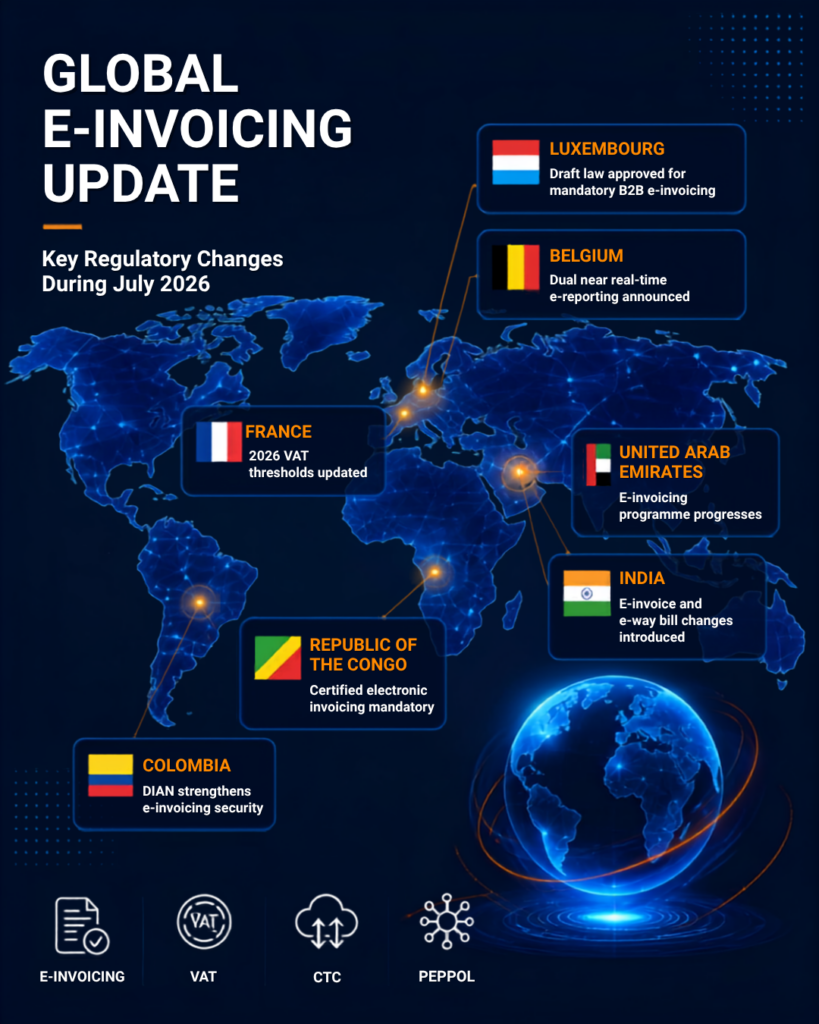
July 2026 delivered a series of important e-invoicing regulatory updates that will impact organisations trading internationally or preparing for mandatory electronic invoicing. Across Europe, Asia, Africa, the Middle East and Latin America, governments continue to strengthen compliance frameworks, expand digital reporting requirements and increase the adoption of Continuous Transaction Controls (CTCs).
Luxembourg approves draft law for mandatory B2B e-invoicing
One of the most significant European developments during July was Luxembourg’s approval of a draft law supporting the introduction of mandatory B2B e-invoicing. The move demonstrates the continued expansion of electronic invoicing requirements across Europe and aligns with the broader regional trend towards increased tax authority visibility and automated reporting.
For businesses operating across multiple European markets, the announcement highlights the importance of ensuring e-invoicing solutions are capable of supporting new country-specific requirements as they emerge.
Belgium introduces dual near real-time e-reporting framework
Belgium announced plans to introduce a dual near real-time e-reporting model, reinforcing the growing shift towards more immediate transaction reporting. Tax authorities across Europe are increasingly seeking faster access to transactional data in order to improve compliance monitoring and reduce VAT fraud.
The proposed framework reflects a wider trend towards real-time or near real-time reporting, requiring businesses to ensure finance systems can capture, validate and exchange invoice data quickly and accurately.
France continues to refine its digital tax framework
France announced updates including revised VAT thresholds for 2026 while continuing preparations for its national e-invoicing and e-reporting programme. France remains one of Europe’s most ambitious Continuous Transaction Control (CTC) initiatives and continues to be closely monitored by organisations operating across the region.
The continued policy activity demonstrates France’s commitment to modernising VAT reporting and preserving momentum towards its future digital tax objectives. Businesses with French operations should continue to monitor developments and implementation requirements closely.
UAE e-invoicing programme moves forward
The United Arab Emirates achieved an important milestone during July with additional progress relating to accredited service provider capabilities supporting the country’s future e-invoicing framework. This represents another step towards the implementation of the UAE’s digital invoicing strategy and signals continued momentum within the region.
As more countries adopt structured electronic invoice exchange frameworks, organisations operating internationally will increasingly benefit from solutions that support multiple regulatory models and interoperability standards.
India introduces further e-invoice and e-way bill changes
India announced additional changes affecting both e-invoicing and e-way bill requirements during July. As one of the world’s most mature e-invoicing markets, India continues to refine its regulatory framework to enhance compliance and improve transaction transparency.
The updates demonstrate how established e-invoicing programmes continue to evolve even after implementation, highlighting the need for businesses to regularly review processes and maintain alignment with changing technical and compliance requirements.
Republic of the Congo advances mandatory electronic invoicing
The Republic of the Congo announced that a certified electronic invoicing system will become mandatory, reflecting the increasing adoption of digital tax controls across African markets. Governments across the continent continue to explore digital compliance initiatives as part of broader tax modernisation programmes.
The development highlights the growing global reach of e-invoicing and reinforces the importance of maintaining visibility over regulatory developments beyond traditional European and North American markets.
Colombia strengthens electronic invoicing security
Colombia’s tax authority introduced measures to strengthen security within the country’s electronic invoicing environment. Security, authenticity and data integrity remain key priorities for tax administrations as digital invoice exchange becomes increasingly widespread.
Organisations operating in Colombia should review any changes carefully and ensure internal processes continue to support evolving compliance expectations.
What this means for finance teams
Governments worldwide continue to expand digital tax reporting, mandatory electronic invoicing and real-time compliance frameworks. For organisations operating internationally, finance systems must be capable of supporting multiple invoice standards, exchanging documents through digital networks and adapting quickly as regulatory requirements evolve. Businesses that invest in scalable, compliant automation today will be significantly better positioned to meet future obligations while also improving efficiency, reducing manual processing and strengthening financial controls.
How Documation can help
Documation helps organisations automate Purchase-to-Pay and Accounts Payable processes while supporting global e-invoicing and compliance requirements. Our solutions integrate with existing ERP and finance systems, helping businesses prepare for changing legislation without disrupting day-to-day operations.
As e-invoicing regulations continue to evolve across the UK, Europe and beyond, staying informed is essential. We will continue to monitor developments and provide updates as new mandates, technical specifications and implementation timelines are announced