And why sending invoices digitally does not automatically create interoperability.
For years, finance teams have worked hard to move away from paper invoices.
Invoices arrive by email rather than post. They’re stored electronically rather than in filing cabinets. Many organisations have introduced intelligent invoice capture solutions and automated workflows.
So it is understandable that many finance professionals ask:
“If we’re already sending and receiving invoices digitally, aren’t we already doing e-invoicing?”
The short answer is: not necessarily.
One of the biggest misconceptions surrounding e-invoicing is that digital delivery alone is enough. It isn’t.
Sending a PDF by email may be digital, but digital delivery and true e-invoicing are two very different things. This is why the distinction between a PDF invoice vs e-invoice matters for finance teams preparing for more automated, interoperable processes.
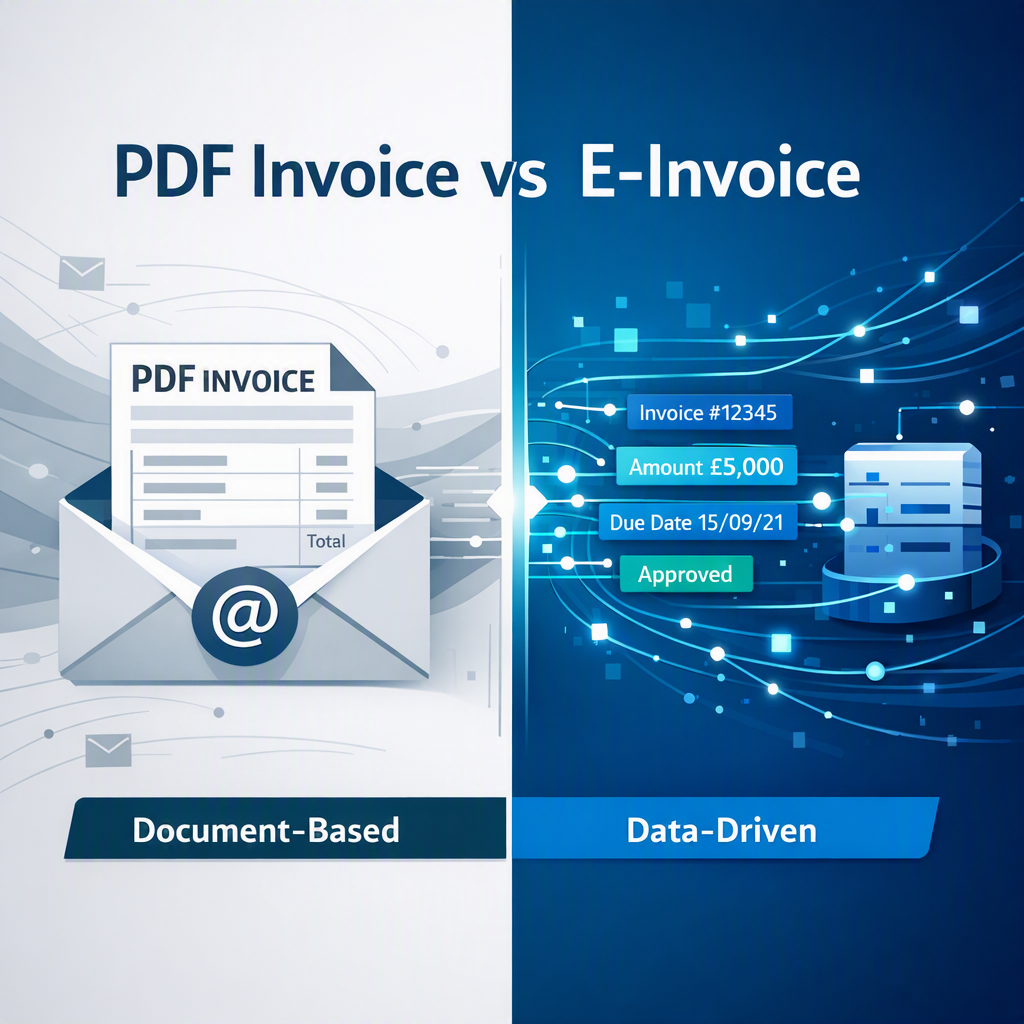
A PDF is a document. An e-invoice is data.
The key distinction is not how the invoice is delivered.
It’s how the information within the invoice is structured.
A PDF is designed for people to read.
It presents information visually, just like a printed invoice would. The invoice number, supplier details, VAT amounts and line items are all visible on the page.
But for your finance system, that PDF is essentially an image of an invoice.
Even when modern Intelligent Document Processing (IDP) or AI-based capture technologies are used, the system must still identify, interpret and extract the information from the document before it can be processed.
A true e-invoice works differently.
The invoice data is already structured and machine-readable before it reaches the recipient.
Instead of reading a document, the receiving system receives the invoice data itself.
There is no need to identify where the invoice number appears on a page, interpret a supplier address or determine which figure represents VAT.
The information arrives in a predefined format that both systems understand.
Digital delivery does not equal interoperability
This is where many organisations become confused.
An invoice sent by email has certainly been delivered digitally.
But digital transmission alone does not create interoperability.
Interoperability simply means that different systems can exchange and process information consistently and automatically.
Think about what happens when a PDF invoice arrives in an inbox.
- The supplier’s ERP system creates an invoice.
- That invoice is converted into a PDF.
- The PDF is attached to an email.
- The recipient receives the email.
- Then another solution must capture, extract and validate the information before it can enter the finance system.
At every stage, the invoice remains a document being passed between people and systems.
The systems themselves are not truly exchanging invoice data.
In contrast, an e-invoice allows the data to move directly between connected systems in a structured format.
- The sender’s system creates the invoice data.
- The recipient’s system receives the same data.
- Both parties understand exactly what each field means.
No interpretation is required.
That is interoperability.
Why this matters to finance teams
For finance professionals, this distinction is about far more than technology.
It directly affects efficiency, accuracy and scalability.
Many finance teams have spent years improving invoice processing by introducing OCR and automation technologies. These solutions deliver significant benefits and will continue to play an important role in invoice handling.
However, they still sit on top of a document-based process.
E-invoicing changes the process itself.
Instead of extracting information from a document, the data arrives ready to process.
This creates opportunities to:
- Reduce manual intervention
- Improve data quality
- Accelerate processing times
- Increase visibility and traceability
- Strengthen audit controls
- Support higher levels of automation
The conversation moves from capturing invoices more efficiently to exchanging invoice data more intelligently.
Why interoperability is becoming increasingly important
The growing focus on e-invoicing across Europe and internationally is not simply about digitising paperwork.
Governments are increasingly interested in creating standardised methods for exchanging structured invoice data between organisations.
This is because structured, interoperable invoice data can support:
- Faster processing
- More accurate tax reporting
- Improved compliance
- Better visibility across supply chains
- Reduced administrative burden
The objective is not simply to replace paper with PDFs.
It is to enable systems to exchange information reliably and consistently.
That requires more than digital delivery.
It requires interoperability.
The question finance leaders should be asking
“Can we send or receive PDF invoices?”
Most organisations already can.
The more useful question is:
“Can our systems exchange structured invoice data effectively?”
That shift in thinking changes the conversation.
It moves the focus away from documents and toward readiness.
Readiness across systems.
Readiness across suppliers.
Readiness across processes.
Readiness across data.
Because the challenge ahead is not simply receiving invoices electronically.
It’s ensuring your organisation is ready to participate in a truly interoperable e-invoicing environment.
Closing thought
Paper invoices became PDF invoices.
The next step is not a better PDF.
It’s structured data.
Because while a PDF may digitise the document, e-invoicing digitises the information itself. Understanding the difference between a PDF invoice vs e-invoice is what ultimately enables interoperability, automation and the future of finance operations.